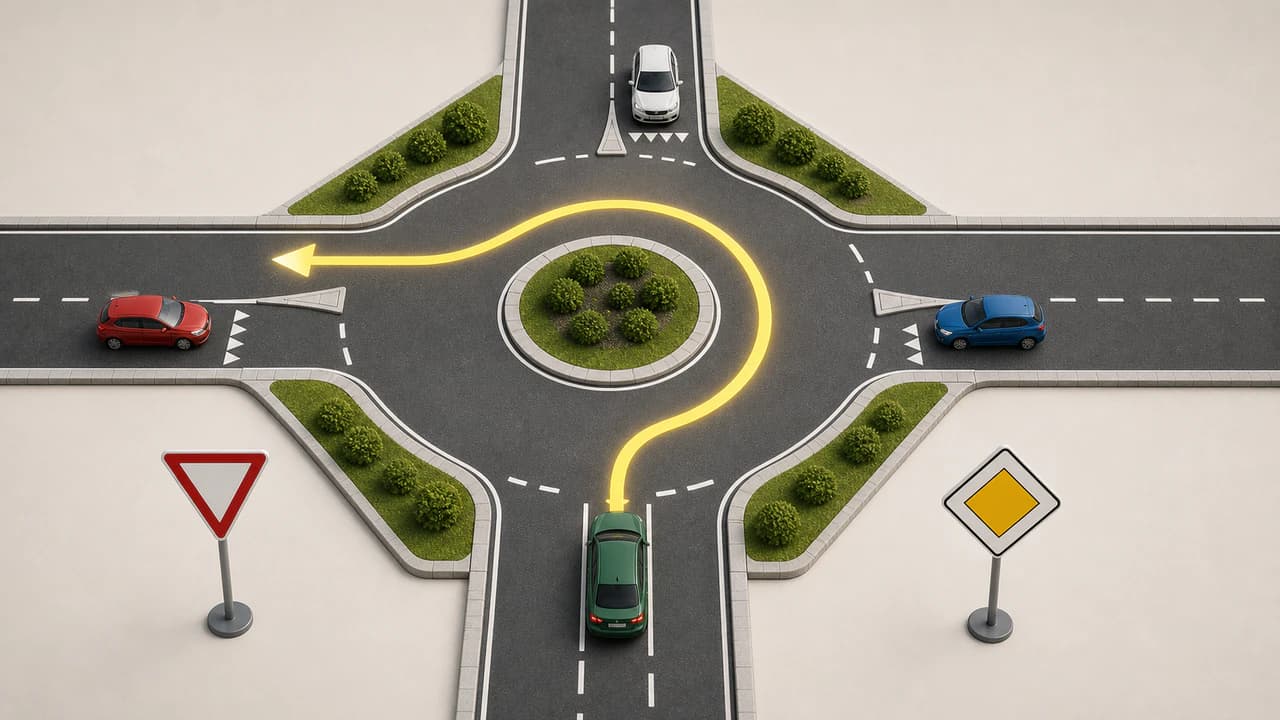
A roundabout becomes easier when you divide it into three decisions: entering, circulating and leaving. Do not try to solve all three by choosing an exit and rushing towards it.
Check the entry
Read the roundabout and priority signs, then look for traffic already circulating. Reduce speed early enough to assess a safe gap. A car’s indicator is useful information, but do not enter solely because you expect it to leave: watch its actual path.
Not every circular-looking junction has the same legal arrangement. Identify the signs rather than deciding from the shape of an island alone.
Choose and keep a suitable lane
Follow lane arrows and markings. In a roundabout with several lanes, changing lanes remains a manoeuvre: check mirrors and the blind spot, signal and yield where required. Being in an inner lane does not give you a right to cut across the outer lane to reach your exit.
If you cannot leave safely, continue around where the markings allow it and try again. Missing an exit is less serious than creating a conflict to avoid a detour.
Signal the exit, not an entitlement
Use the right indicator when leaving. A left indicator is not compulsory simply because you plan to travel most of the way around a Belgian roundabout. Signal any actual lane change appropriately, but remember that signalling does not grant priority.
Before exiting, check for cyclists alongside you and pedestrians at the crossing. Move your attention beyond the car immediately in front: the exit itself may be blocked.
Try this practice scenario
You are inside a two-lane roundabout, but another car remains on your right as your exit approaches. Your next action is not to insist on leaving. Maintain a predictable path and look for a later safe opportunity, respecting the lane markings.
When reviewing a question, name the entry sign, your lane and the road user whose path you would cross. That explanation is more reliable than a memorised “first exit, right lane” shortcut.
Official sources
Rules and procedures checked on 21 September 2026. Follow the linked authority for later changes; rules announced for a future date are not yet in force.