Priority questions are difficult because several rules may appear in the same picture. The solution is to apply them in a fixed order rather than guessing which vehicle “looks first”.
Rules and exam procedures can change. This article reflects information checked in July 2026 and is independent from Belgian authorities and exam centres.
Start with the controlling instruction
At every conflict point, scan in this order:
- Directions from an authorised agent.
- Working traffic lights.
- Priority signs and road markings.
- General rules, including priority to the right.
If a police officer directs traffic, a green light or a priority sign cannot cancel that direction. If lights control the movement, do not fall back on priority to the right for movements governed by those lights.
Priority to the right
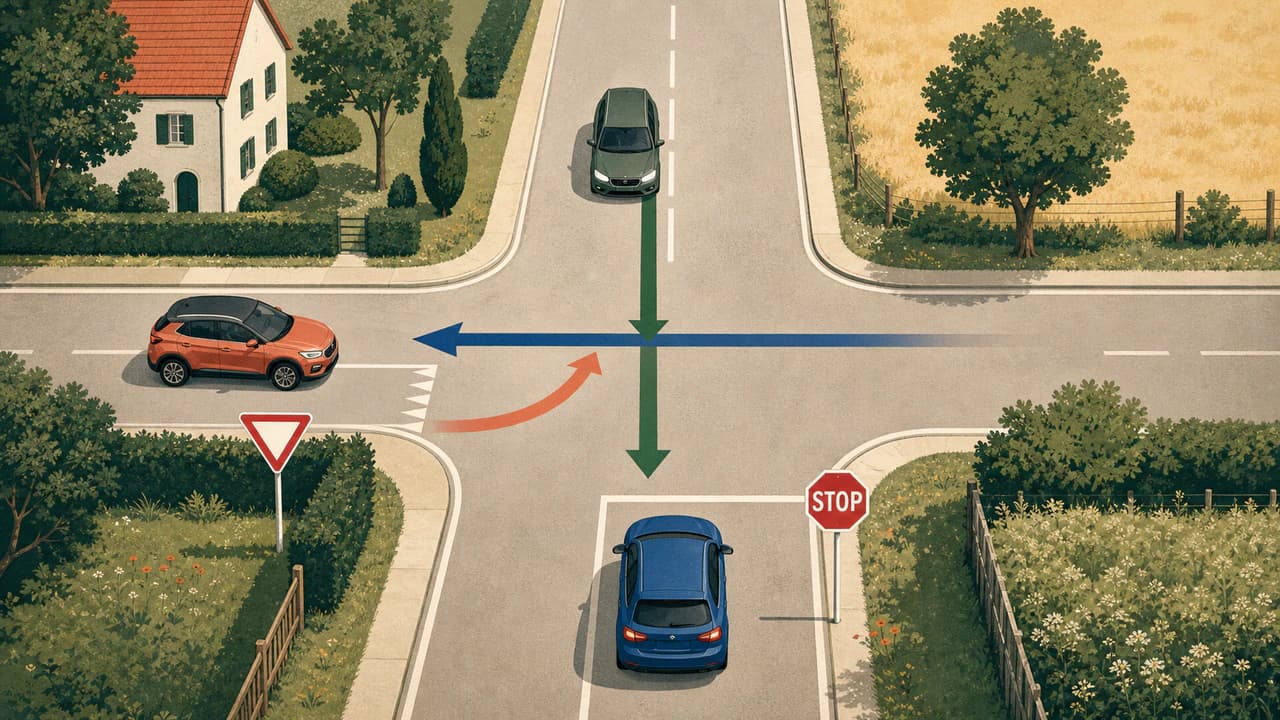
At an intersection without another controlling instruction, a driver generally yields to a driver approaching from the right. Do not turn it into “the first vehicle to arrive goes first”. Approach slowly enough to observe the right-hand road and stop if needed.
Priority to the right is not a licence to drive blindly. A driver with priority must still avoid a foreseeable collision.
Give way, STOP and the priority road
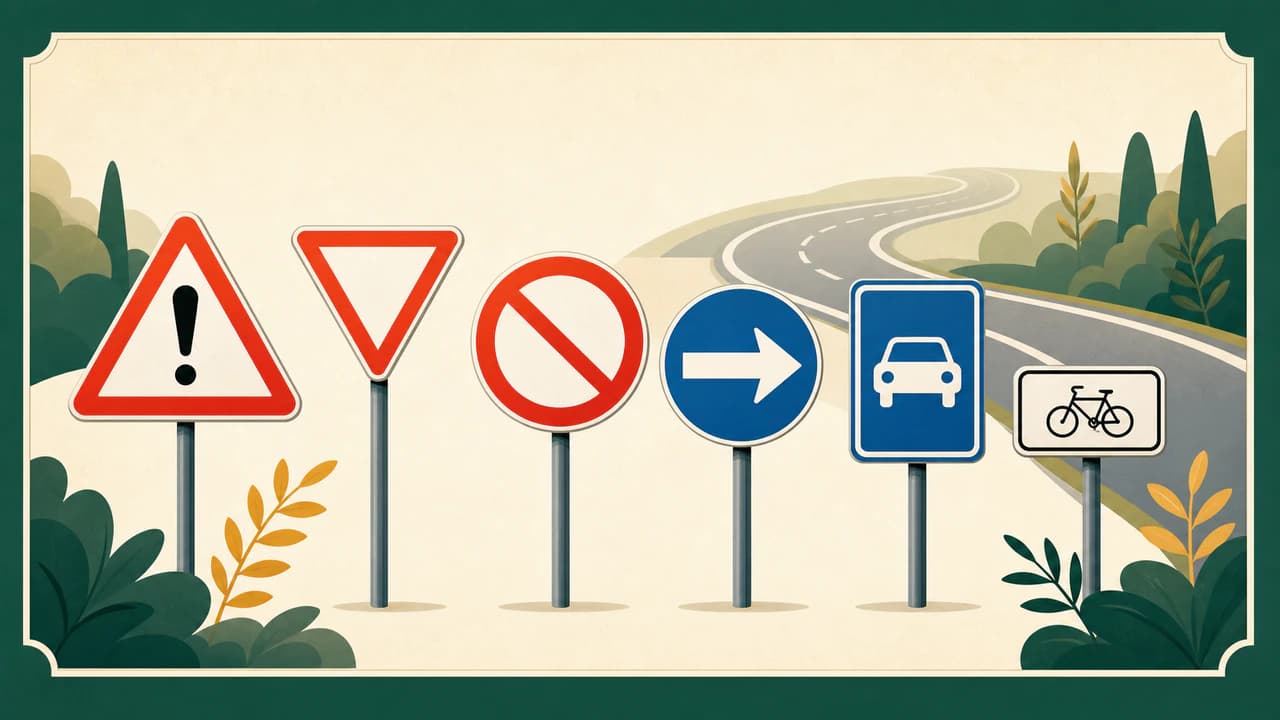
An inverted triangle requires you to yield. You may continue without a full stop only if visibility and traffic allow it. A STOP sign requires a complete stop at the line, or at the safest visible point if no line is present, followed by yielding.
The yellow-diamond priority-road sign gives priority at subsequent intersections. Watch for its end sign and for diagrams showing the route of the priority road through a junction. A bend in the thick line can mean that continuing “straight” visually is not the priority route.
Roundabouts
Do not assume every circular junction works identically. On the usual signed roundabout, entering traffic faces give-way signs and yields to traffic already circulating. Observe the actual signs and lane arrows. Signal when leaving and position early without cutting across another lane.
Manoeuvres change the answer
A driver performing a manoeuvre must yield to other road users. Manoeuvres include leaving a parking space, reversing, making a U-turn, changing lane or entering the road from private property. In exam scenes, first ask whether one vehicle is carrying out a manoeuvre before applying a simple left-versus-right shortcut.
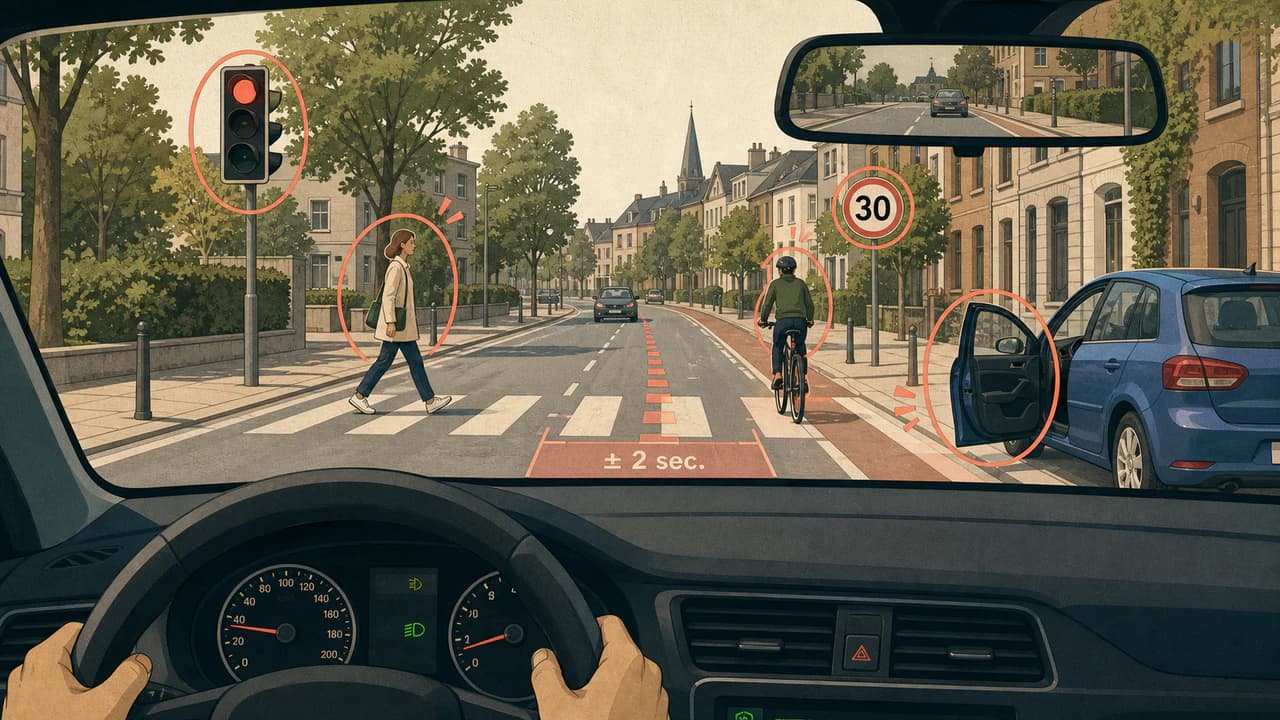
Turning drivers must also protect pedestrians and cyclists crossing the road they enter. Check both the carriageway and any parallel cycle track.
Trams, emergency vehicles and narrow passages
Trams have special priority rules, so never treat them as ordinary cars in a right-to-left puzzle. Authorised emergency vehicles using the required signals must be allowed to pass safely. At a narrow passage, paired signs can assign priority to one direction, but the driver with priority still waits if the passage cannot be cleared safely.
A reliable five-question routine
- Who is directing or controlling traffic?
- Which signs and lines apply to each approach?
- Is anyone performing a manoeuvre?
- Which paths actually cross?
- After the first vehicle moves, what changes for the others?
Trace one conflict at a time. Vehicles whose paths do not intersect can sometimes move together.
Common traps
- Applying priority to the right despite a give-way sign.
- Believing arrival order decides an unsigned intersection.
- Ignoring a cyclist beside the main carriageway.
- Assuming a roundabout automatically gives circulating traffic priority without reading signs.
- Using your indicator as if it created priority.
- Forcing priority when another road user has made a mistake.
Practise by saying the controlling rule before naming the vehicle order. That habit makes unfamiliar diagrams far easier to solve.