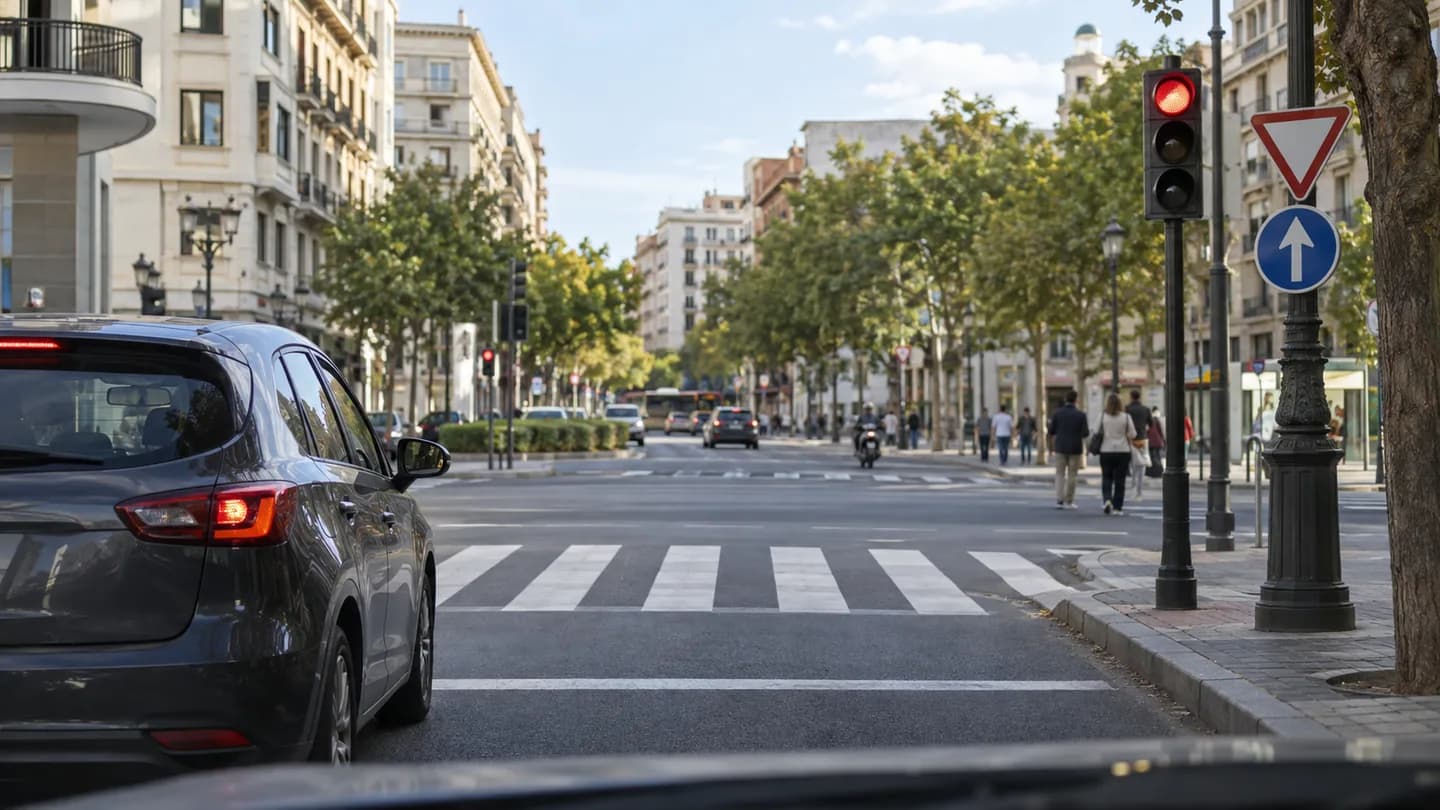

Permission and a clear view are separate checks
A broken centre line does not guarantee that overtaking is safe. You still need visibility, room and a way back into your lane without forcing another road user to brake or change direction. A van ahead can hide oncoming traffic.
Before answering a theory question, identify the road marking, what you intend to pass and whether you can complete the whole manoeuvre safely.
A slow car does not create an exception
You cannot cross a solid line simply because the car ahead is slow. Cars and motorcycles also no longer have the former allowance to exceed a conventional road’s speed limit by 20 km/h when overtaking; that allowance ended in 2022.
Imagine following a van into a bend beside a solid centre line. Impatience changes neither the marking nor your view. Keep room to observe and wait for a permitted, safe opportunity.
Passing cyclists under the current rule
Article 85 requires at least 1.5 metres laterally and use of part or all of the adjacent or opposing lane. Where there is more than one lane in your direction, a complete lane change is mandatory. Do not endanger or obstruct oncoming users, including those on the shoulder.
Since 1 October 2026, when passing the vulnerable users listed in that article outside built-up areas, travel at least 20 km/h below the road’s limit before starting and throughout the manoeuvre. On a section limited to 90 km/h, that means at most 70 km/h for this manoeuvre, alongside the other safety requirements. It is not a blanket rule for passing every car.
Solid lines and stationary vehicles
Article 88 provides specific exceptions, including cycles and certain other users, when the manoeuvre can be completed safely. It distinguishes immobilised vehicles from vehicles stopped because of traffic. A queue is not the same situation as a breakdown.
For passing a vehicle immobilised by a breakdown, accident or the services listed in Article 88.1, the current wording requires at least 1.5 metres and a speed reduction of 20 km/h relative to the limit. Read the precise situation rather than memorising an absolute slogan about solid lines.
A useful order for reading the picture
Check the marking or sign, identify the user or reason for immobilisation, then check space, speed and visibility. If any required condition is missing, wait.
Use the free Spanish theory test to practise applying rules. Mazlet’s questions are original learning exercises, not official DGT exam questions.
Official sources
Sources checked: October 13, 2026.