
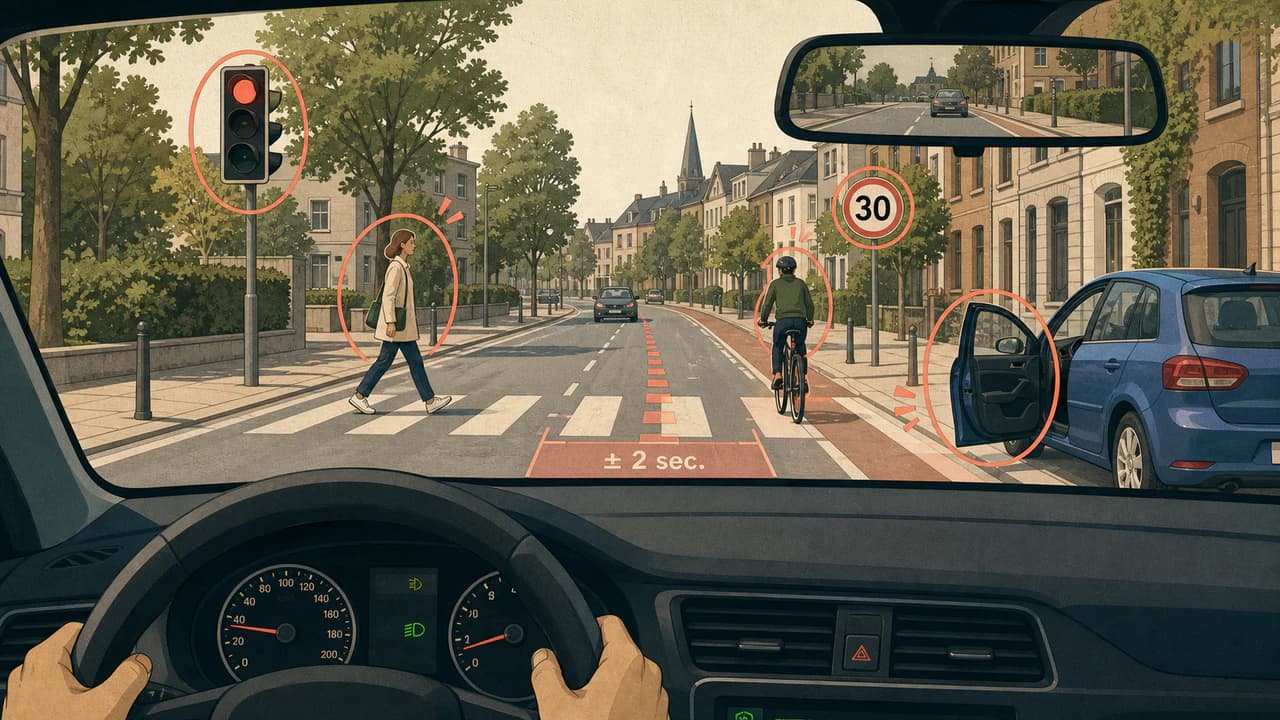
Not every Belgian theory-test mistake has the same impact. The exact procedure is regional, but official information for Flanders states that a wrong or unanswered ordinary question costs one point, while an error about a third- or fourth-degree offence or the authorised maximum speed costs five points. Wallonia also describes a serious error as a five-point deduction.
The exam commonly contains 50 multiple-choice questions and requires at least 41/50, but always confirm the current rules with the authority for the region where you will sit it.
What deserves “serious mistake” attention
Do not try to memorise a secret list of questions. Learn the safety logic behind high-consequence rules:
- Obeying police directions, traffic lights, STOP, no-entry and access restrictions.
- Choosing the correct maximum speed and adapting below it when conditions demand.
- Protecting pedestrians and cyclists at crossings and while turning.
- Never crossing a solid line or entering a prohibited direction when the rule forbids it.
- Safe overtaking, especially around crossings, junctions, bends and vulnerable users.
- Alcohol, drugs, distraction and the conditions for safe vehicle control.
- Level crossings, motorways, tunnels and emergency situations.
A hazard-reading routine
Before answering, scan the whole scene:
- Control: agent, lights, signs and road markings.
- Vulnerable users: pedestrians, cyclists, children and people with reduced mobility.
- Movement: who is turning, changing lane, reversing or leaving a parking place?
- Space: stopping distance, blind spots, doors and escape room.
- Speed: legal maximum and safe actual speed.
Only then read the options. This prevents a plausible answer from hiding the decisive hazard.
Common high-impact errors
Treating a maximum as a recommended speed
The sign gives a ceiling, not a promise that the road is safe at that number. A wet road, poor visibility or a crowded crossing requires less.
Looking at cars but missing cyclists
Cycle tracks can cross the path of a turning car. Check to the side and behind before turning, not only the lane ahead.
Confusing stopping with parking
A no-stopping restriction is stronger than no parking. Learn the sign pair and the legal distinction.
Assuming the indicator grants priority
An indicator communicates intention. It does not cancel another road user’s priority and does not make an unsafe lane change acceptable.
Rushing the wording
Words such as “must”, “may”, “maximum”, “immediately” and “except” change the rule. Use the available answer time to identify exactly what is being asked.
How to practise
Track mistakes by rule, not just by score. After every wrong answer, write one sentence: the controlling rule, the missed clue and the safer decision. Repeat high-impact topics in mixed scenes until the reasoning is automatic.
Mazlet provides original practice questions and learning material. It is not affiliated with GOCA, Mijn Rijbewijs B, government authorities or examination centres, and it does not reproduce official exam questions.